Funny Picture of Tired Going Up Stairs
A gait abnormality is an unusual walking pattern. Many young children may have an abnormal gait for a period of time equally they grow and learn to walk.
Many parents worry near their children'southward unusual walking patterns, even so, gait abnormalities are a regular part of concrete development. The vast majority of kids grow out of gait abnormalities without medical handling.
When do babies start walking?
Babies typically start walking when they are effectually ane year old. From at that place, they spend the adjacent several years developing rest and leg forcefulness.
The following age ranges are considered average for developmental milestones. Some children reach these milestones earlier and some achieve them later. If yous are concerned about your babe's physical development, talk with your pediatrician.
Developmental milestones
- Around 6 months, most babies can sit down with back up and roll over
- Around 9 months, most babies learn to crawl.
- Around 9-12 months, nearly babies will pull themselves upward to standing by holding onto furniture. Babies at this stage can walk with support but tin can't yet walk on their own.
- By 11-16 months, most babies volition start to walk without back up.
- Past 2 years, well-nigh toddlers tin can go upward stairs i at a time and jump in place.
- By 3 years, most children tin can get up stairs reciprocally and stand up on one pes.
- By 4 years, most children can become down stairs reciprocally and hop on one foot.
What are the most mutual types of pediatric gait abnormalities?
The well-nigh common types of gait abnormalities in children are intoeing and outtoeing.
- Intoeing is walking with the anxiety turned inward.
- Outtoeing is walking with the feet turned outward.
Intoeing and outtoeing are usually not painful.
Several common conditions tin can cause your child'south feet to plow inward or outward in their early on years, including tibial torsion and femoral rotation (described below). Each of these weather typically amend on their own during childhood.
What causes pediatric gait abnormalities?
Tibial torsion
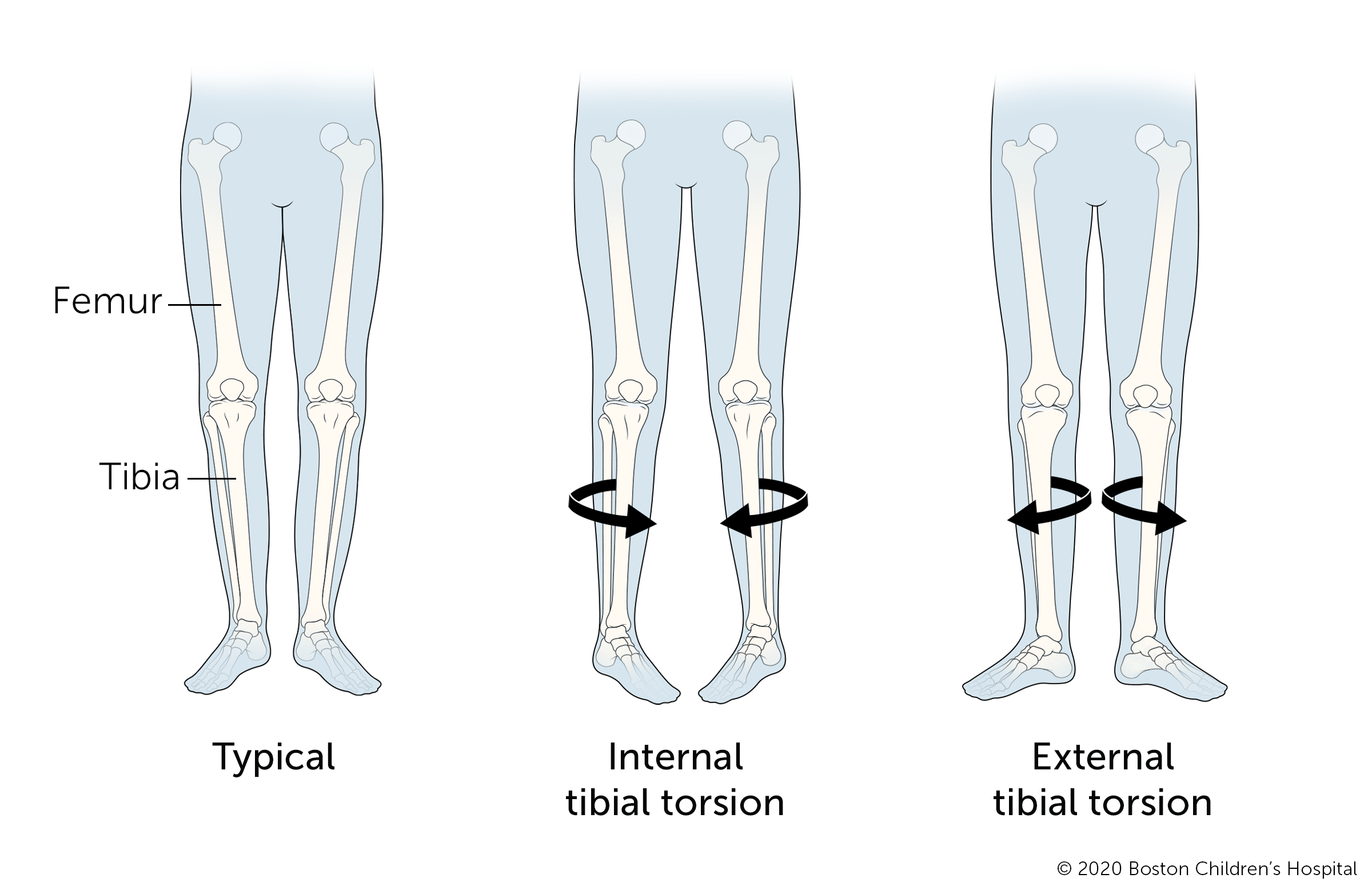
Tibial torsion is the turning of a child'southward lower leg (tibia) either inward (internal tibial torsion) or outward (external tibial torsion). The status often improves without treatment, usually earlier a child turns 4.
Some children with tibial torsion wear a night brace between 18 to 30 months sometime, but this is not common. Doctors merely consider surgery for tibial torsion if a child still has the condition when they are 8 to 10 years old and having meaning walking problems.
Femoral version
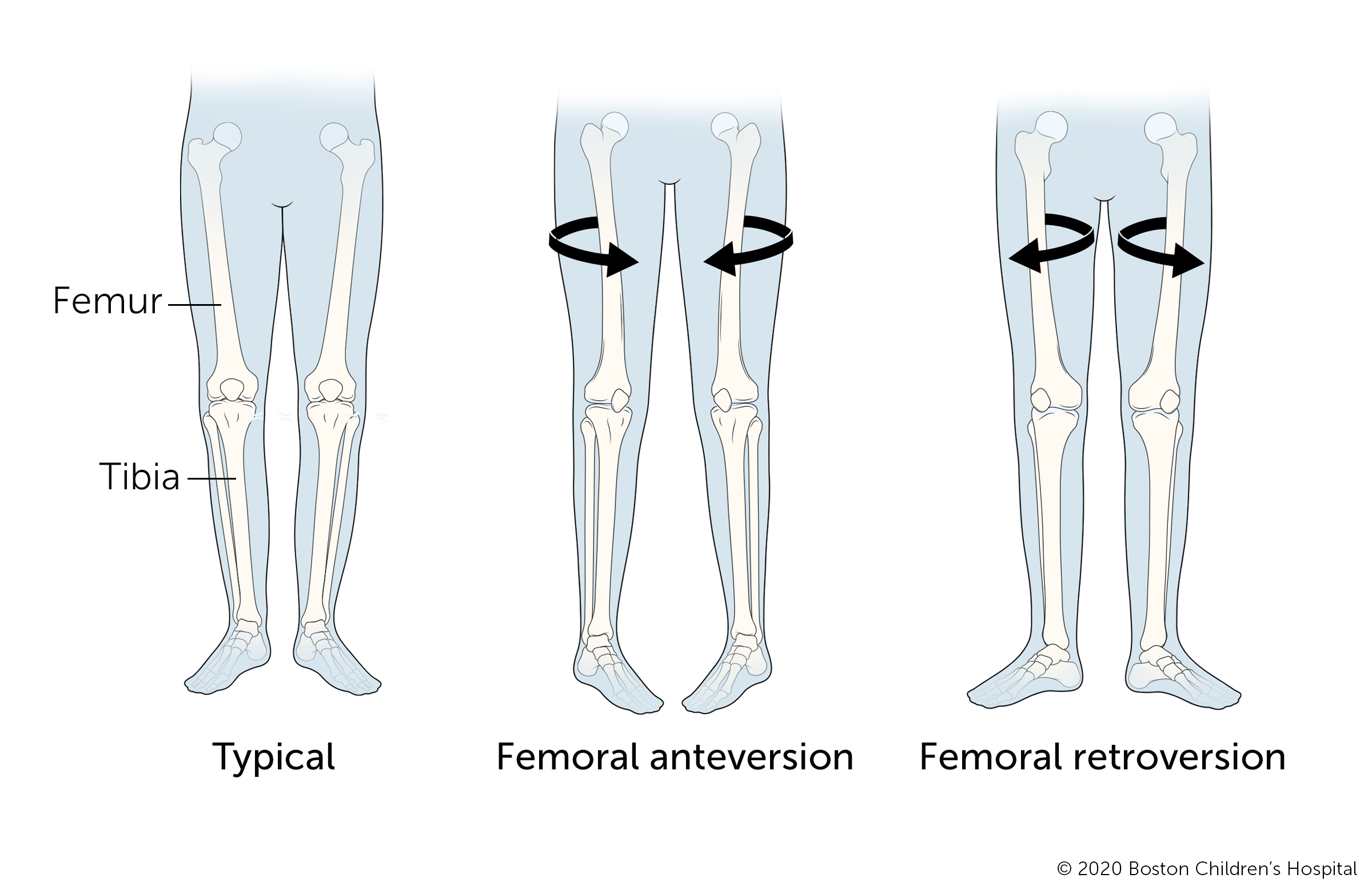
Femoral version describes a kid's upper leg bone (femur) that twists inwards or outward. In twisting of the femur (femoral anteversion) causes the feet to betoken inward. Signs of femoral anteversion ordinarily start become noticeable when a kid is betwixt 2 to 4 years erstwhile, a time when inward rotation from the hip tends to increase. The status usually gets better without treatment.
Outward twisting of the femur is called femoral retroversion and causes the anxiety to indicate outward. It is less common than femoral anteversion. In some cases, femoral retroversion may filibuster a child'southward walking, however, the condition oft gets better without medical intervention.
Doctors consider surgery for femoral anteversion or femoral retroversion only if a kid is older than nine and has a very severe condition that causes a lot of tripping and an cruddy gait.
Bowlegs and knock knees
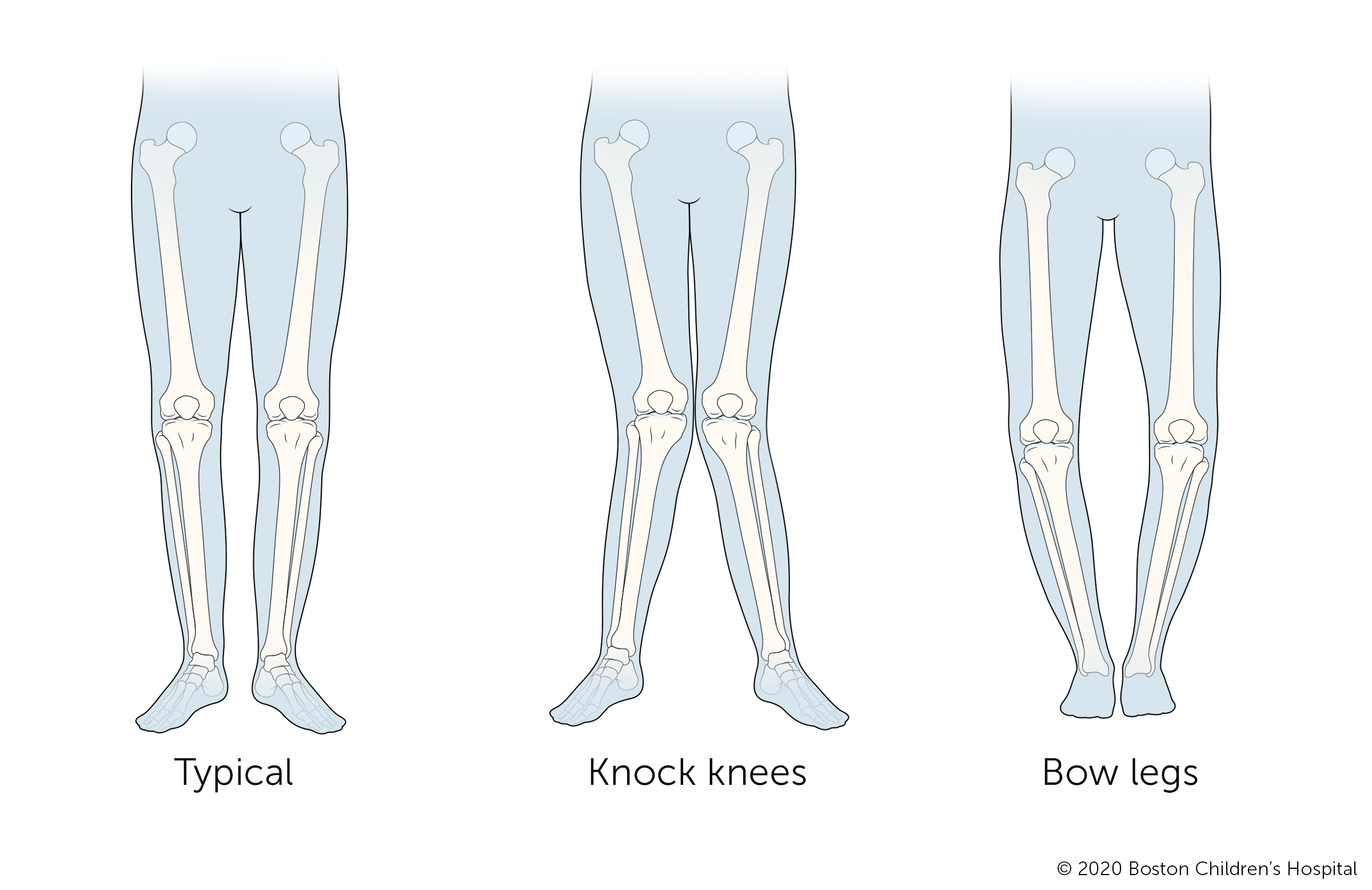
Bowlegs is an outward curve of the legs at the knees. Knock knees is an inward curve of the legs at the knees. Both bowlegs and knock knees are common stages of evolution and normally self-correct as a kid grows.
Flatfeet
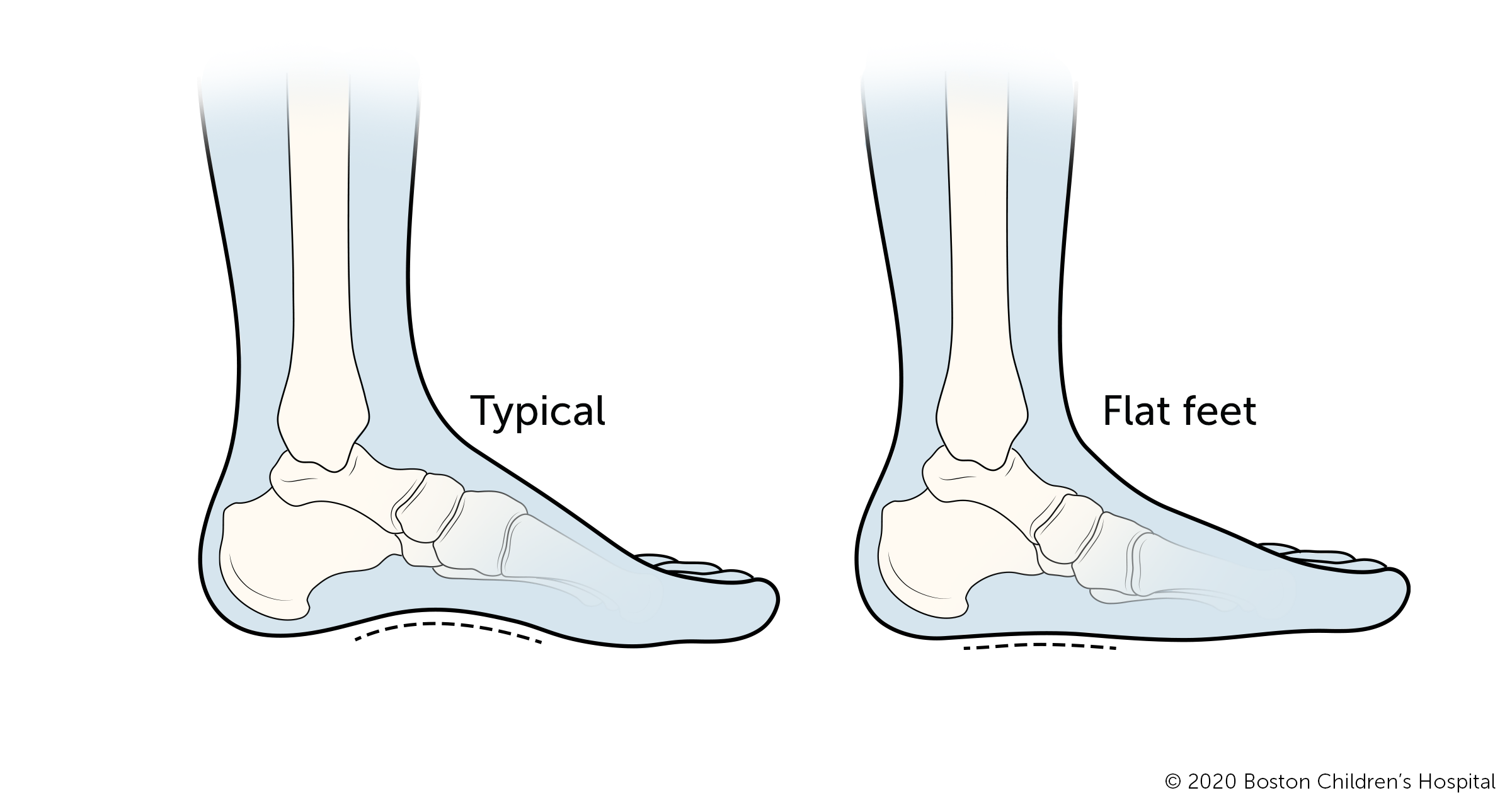
Flatfeet are normal in infants and young children. Children take flat feet when the arches in their anxiety have not yet developed and their entire feet printing against the flooring. The arches develop throughout childhood until nearly age x.
Metatarsus adductus
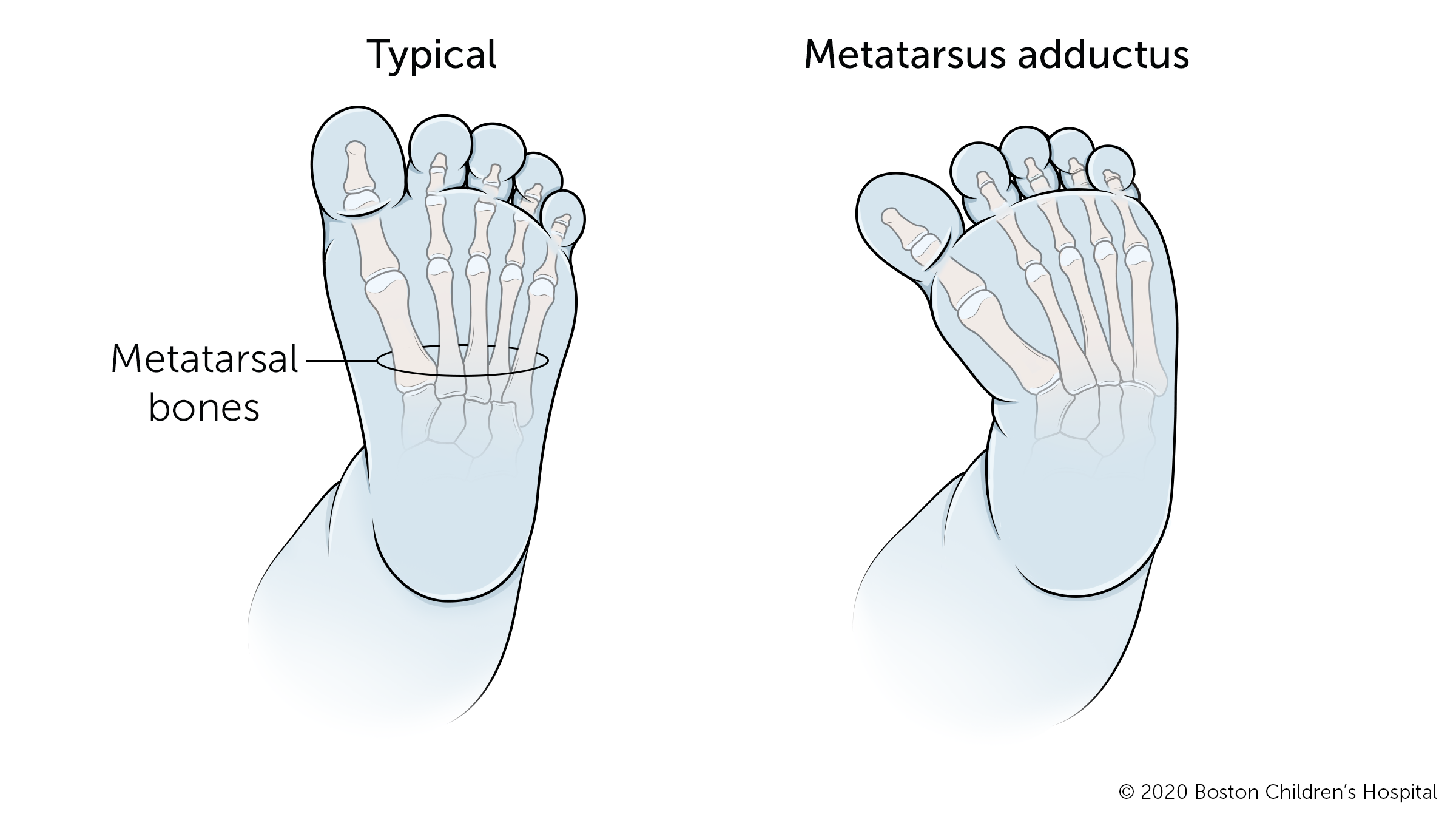
Metatarsus adductus is a common positional deformity that causes a child's feet to curve inwards from the middle of the foot to the toes. In severe cases, it may resemble clubfoot. The condition improves on its ain most of the time.
Babies with astringent metatarsus adductus may demand treatment, which usually involves special exercises, casts, or special corrective shoes. These treatments have a high charge per unit of success in babies from 6 to ix months old.
Limping
Sudden limping is virtually likely due to pain caused past a minor, hands treated injury. Splinters, blisters, or tired muscles are common culprits. Less often, limping tin involve a more serious problem such as a sprain, fracture, dislocation, articulation infection, or autoimmune arthritis. In rare cases, a limp may be the commencement sign of a tumor.
Non-painful chronic limping may be sign of developmental problem, such equally a leg length discrepancy or hip dysplasia or a neuromuscular problem, such every bit cerebral palsy.
Toe walking
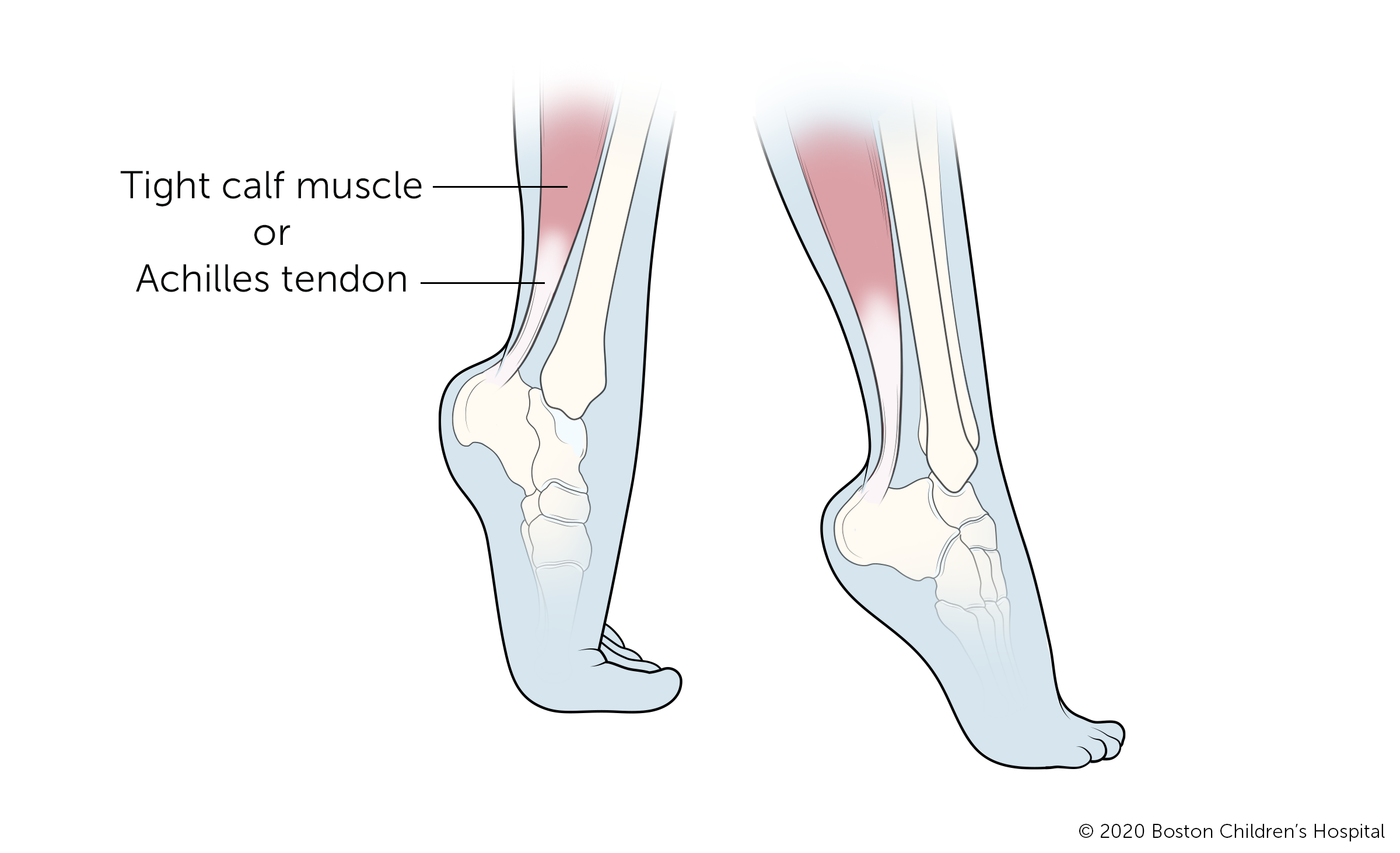
Toe walking is a common gait abnormality, especially in young children who are only starting to walk. In near cases, this will resolve on its own over time without intervention. However, children who walk normally for a menstruation and and so later brainstorm to walk on their toes, or children with tightness of their Achilles tendons, should exist evaluated by a physician.
Many cases of persistent toe-walking run in families or are caused past tight muscles. Treatment may involve observation, physical therapy, bracing, casting, or surgery. In some cases, toe-walking may indicate a neuromuscular disorder such as cognitive palsy or it could be a sign of developmental dysplasia of the hip or leg length discrepancy.
How are gait abnormalities diagnosed?
Your child's doctor will perform a concrete exam and watch your child as they walk or run. They may look to run into whether your child'southward legs are shaped the aforementioned or differently. They may also ask if your child shows any signs of being in pain when they walk and whether whatsoever members of your close family have had long-term walking problems.
Other diagnostic procedures may include:
- X-ray: A diagnostic test that produces images of internal tissues, bones, and organs that tin exist used to wait at bone structure and alignment.
- Magnetic Resonance Imaging (MRI): A diagnostic procedure that produces detailed images of soft tissues and structures within the body. This test is sometimes used to rule out whatever associated abnormalities of the spinal cord and fretfulness.
- Computerized Tomography browse (likewise called a CT or True cat browse): A diagnostic imaging procedure that shows detailed images of the bones and joints.
How are pediatric gait abnormalities treated?
In virtually cases, a child with an abnormal gait is observed over the course of several years. The dr. will monitor your kid's walking patterns to ensure their legs continue to develop and their walking patterns become more typical over time. Fortunately, most causes of gait abnormalities will resolve without any intervention every bit a child grows.
If a gait aberration is caused past an injury or developmental condition, your child's md will treat that condition. Handling for gait abnormalities that exercise non resolve may include surgery and is something to talk over with your doctor.
How we treat gait abnormalities at Boston Children'due south Hospital
The Lower Extremity Programme at Boston Children's Hospital offers comprehensive assessment, diagnosis, and handling for children of all ages with conditions affecting their lower limbs. We have extensive experience treating disorders of the anxiety, ankles, knees, legs, and hips. Whether the patient is an infant, child, or boyish, our goal is to aid children live full, contained lives.
Source: https://www.childrenshospital.org/conditions/walking-gait-abnormalities
0 Response to "Funny Picture of Tired Going Up Stairs"
Post a Comment